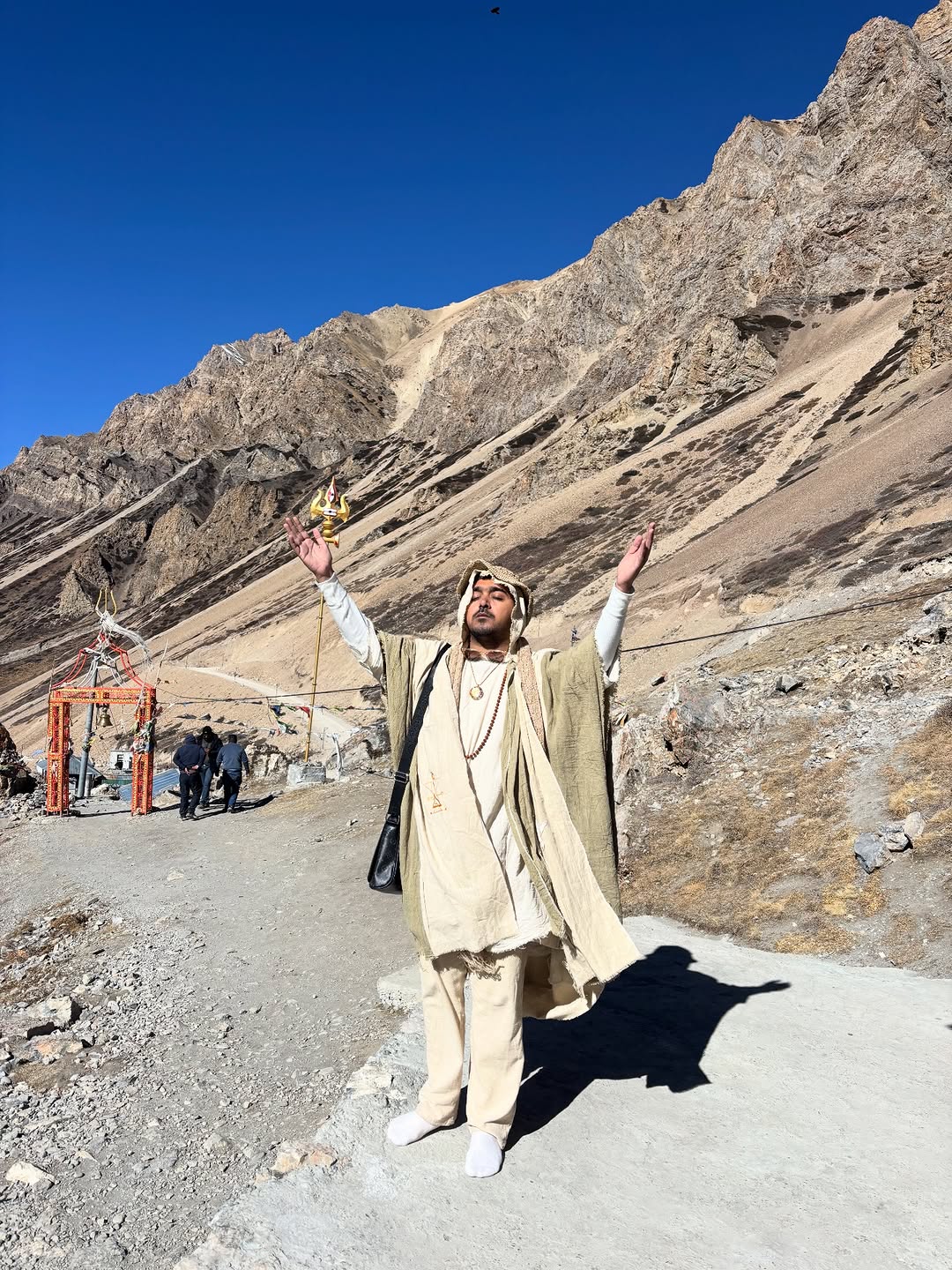
Once a pilgrim has done the Char Dham, the question that follows is almost always the same. Where now, that has the same weight but not the same crowd? Our answer points east, away from Garhwal and into the Kumaon hills near the Tibet border, to a circuit that most of the country has never queued for.
Adi Kailash is sometimes called the Chhota Kailash, the smaller Kailash, because its pyramid of rock and snow mirrors the sacred mountain in Tibet so closely. It rises to nearly 6,000 metres above the Kuthi valley in Pithoragarh district, and the darshan point sits at the village of Jolingkong beneath it. A day’s journey away stands Om Parvat, a face of mountain on which snow settles in the natural shape of the sacred syllable Om, one of the few places on earth where that mark appears without a single human hand.
Why so few people go
Three things have kept these mountains quiet, and all three are now easing.
The road. For decades the approach beyond Dharchula was rough track and long walks, and the journey demanded real trekking. The Border Roads Organisation has pushed motorable road much closer to both Adi Kailash and Om Parvat in recent years, which has turned a hard expedition into a journey that families and older pilgrims can make.
The permit. This is border country, and an Inner Line Permit is required to travel the final stretch. It is straightforward to arrange in advance, but it is not optional, and it is the kind of paperwork that catches independent travellers out at the checkpost. We carry it sorted before anyone sets off.
The altitude. You are moving between roughly 1,500 and almost 6,000 metres, and the body needs time to adjust. The journey is built around acclimatisation, with nights at Nabi, Gunji and the high villages that let you climb gradually rather than all at once.
What the days actually hold
A typical circuit runs about seven days from Nainital or Pithoragarh, threading up through Dharchula and the Kuthi valley, past villages of the Rung community whose culture is as much a part of the journey as the peaks. You stand before Adi Kailash at Jolingkong, you take darshan of Om Parvat, and on a clear morning you see Parvati Sarovar and Gauri Kund, the high lakes that the tradition ties to Shiva and Parvati.
What you do not get is the press of thirty thousand people. At Kedarnath in season the crowd is a small city. At Adi Kailash you are often one of a handful of pilgrims under a mountain that feels like it belongs to the gods alone. The silence is the point.
Who it suits, and who should wait
This is a journey for people who want devotion without spectacle, and who can handle altitude and remoteness. The cold is real, the comforts are simpler than the Char Dham hotels, and the nearest hospital is hours away. We bring medical support and we acclimatise carefully, but a pilgrim with an unmanaged heart or lung condition should do the Char Dham first and build up to this.
For everyone else, it is the rarest kind of pilgrimage left in India: sacred, reachable and still almost empty.
The wider map
Adi Kailash is one mountain in a far larger sacred geography. Kailash Mansarovar itself, the original in Tibet, is the journey many pilgrims hold as the final one, with its own permits, its own route through Kathmandu and a parikrama at over 5,000 metres that asks a great deal of the body. The twelve Jyotirlingas trace a different map again, scattered the length of the country. Each is a yatra in its own right.
We run all of them, end to end, with the permits and the darshan and the high-altitude support handled before you arrive. For the pilgrim whose Char Dham was a beginning rather than an end, this is where the map keeps going.
If you would rather have all of this handled for you, that is what we do. Tell Ritesh where your heart wishes to go.
WhatsApp Ritesh